Wormwood
Artemisia absinthium

Artemisia absinthium
Properties
Antibacterial, antiseptic, astringent
As a medicine
Properties
Anti helmitic, cholagogue, deodorant, digestive, emenagogue, febrifuge, insecticide, narcotic, vermifuge and tonic, abortifacient, antibacterial, antiparasite, astringent, bitter, cholagogue, depurative, nervine
Effects
Artemisia absinthium is traditionally used medicinally in Europe, and is believed to stimulate the appetite and relieve indigestion.
Wormwood is a powerful worming agent that has been used for hundreds of years to expel tapeworms, threadworms, and especially roundworms from dogs, cats, and their humans. Although wormwood makes like miserable for parasites, but neither is it kind to the host.
Contraindications
Essential Oil of Wormwood is a potent poison, due to its high concentration of thujone. It is actually a neurotoxin. So, extreme care should be taken while using wormwood for medicinal purposes and prolonged use should be avoided. Artemisia absinthium contains thujone, a GABAA receptor antagonist that can cause epileptic-like convulsions and kidney failure when ingested in large amounts.
Avoid in pregnancy
Culinary uses
Absinthes and brewing
It is an ingredient in the spirit absinthe, and is used for flavouring in some other spirits and wines, including bitters, vermouth andpelinkovac. In the Middle Ages, it was used to spice mead, and in Morocco it is used as tea. In 18th century England, wormwood was sometimes used instead of hops in beer and is used as an ingredient in the spirit absinthe as well as some other alcoholic drinks.
With the exception of Rue, Wormwood is the bitterest herb known, but it is very wholesome and used to be in much request by brewers for use instead of hops. The leaves resist putrefaction, and have been on that account a principal ingredient in antiseptic fomentations.
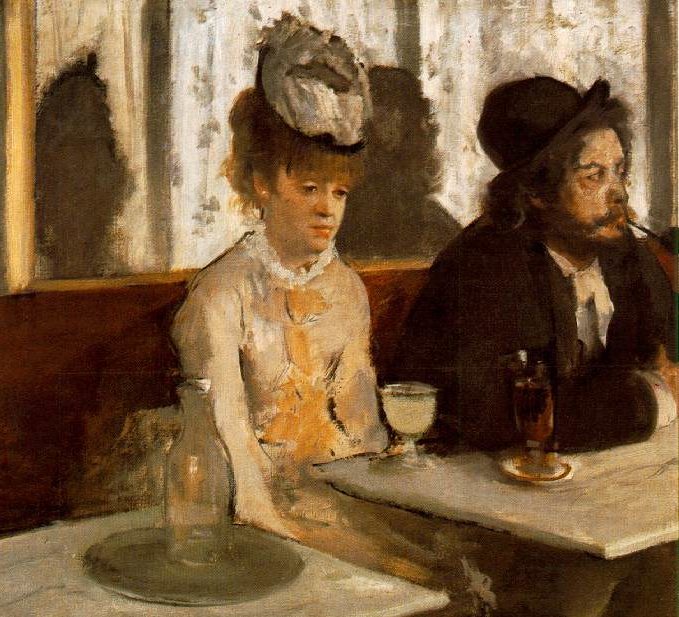
Wormwood is one of the major ingredients in absinthe, a fashionable drink in the nineteenth century that became associated with the death of the American writer Edgar Allan Poe and the suicide of the painter Vincent Van Gogh. It was immortalized in a painting by Edgar Degas, which shows a haunting portrait of two absinthe drinkers, hollow-eyed and oblivious to all but the intoxicating beverage.
Interesting information
As a strewing herb
To repel mice, and laid amongst clothing and furs to repel moths.
As an insecticide
An infusion of the plant is said to discourage slugs and insects. The plant contains substances called sesquiterpene lactones, these are strongly insecticidal.
Cultivation
This herbaceous perennial with attractive silver-green leaves is grown as an ornamental plant.
Origin of name
The genus is named Artemisia from Artemis, the Greek name for Diana
Etymology
The genus is named Artemisia from Ancient Greek ἀρτεμισία, from Ἄρτεμις (Artemis). In Hellenistic culture, Artemis was a goddess of the hunt, and protector of the forest and children. Absinthum comes from the Ancient Greek ἀψίνθιον.
The common English name “wormwood” comes from Middle English wormwode or wermode. The form “wormwood” is attributable to its traditional use as avermifuge..Webster’s Third New International Dictionary attributes the etymology to Old English wermōd (compare with German Wermut and the derived drink vermouth), which the OED (s.v.) marks as “of obscure origin”
Other Names
absinthium, absinthe wormwood, wormwood, common wormwood, green ginger or grand wormwood, Louisiana Artemisia, Cudweed, Western Mugwort, White Sage.
Mythologies and stories
The Common Wormwood held a high reputation in medicine among the Ancients. Tusser (1577), in July’s Husbandry, says:
‘While Wormwood hath seed get a handful or twaine
To save against March, to make flea to refraine:
Where chamber is sweeped and Wormwood is strowne,
What saver is better (if physick be true)
For places infected than Wormwood and Rue?
It is a comfort for hart and the braine
And therefore to have it it is not in vaine.’
According to the Ancients, Wormwood counteracted the effects of poisoning by hemlock, toadstools and the biting of the seadragon. The plant was of some importance among the Mexicans, who celebrated their great festival of the Goddess of Salt by a ceremonial dance of women, who wore on their heads garlands of Wormwood.
William Shakespeare referred to Wormwood in his famous play Romeo and Juliet: Act 1, Scene 3. Juliet’s childhood nurse said, “For I had then laid wormwood to my dug” meaning that the nurse had weaned Juliet, then aged three, by using the bitter taste of Wormwood on her nipple.
Wormwood has been used in medicine from ancient times. Dioscorides and Pliny considered it to be a stomachic tonic, and anthelmintic. Boerhaave, Linnaeus, Haller, and all of the earlier writers speak of its good effects in many disorders. Absinthium is the Latin and pre-Linnaean for wormwood. In Biblical days it was a symbol of calamity and sorrow.
Native range
native to temperate regions of Eurasia and Northern Africa and widely naturalized in Canada and the northern United States
Family/genus
Compositae and belong to the genus Artemisia, a group consisting of 180 species, of which four grow wild in England: the Common Wormwood, Mugwort, Sea Wormwood and Field Wormwood.
Botanical Description
Artemisia absinthium is a herbaceous, perennial plant with fibrous roots. The stems are straight, growing to 0.8–1.2 metres (2 ft 7 in–3 ft 11 in) (rarely 1.5 m, but, sometimes even larger) tall, grooved, branched, and silvery-green. The leaves are spirally arranged, greenish-grey above and white below, covered with silky silvery-white trichomes, and bearing minute oil-producing glands; the basal leaves are up to 25 cm long, bipinnate to tripinnate with long petioles, with the cauline leaves (those on the stem) smaller, 5–10 cm long, less divided, and with short petioles; the uppermost leaves can be both simple and sessile (without a petiole). Its flowers are pale yellow, tubular, and clustered in spherical bent-down heads (capitula), which are in turn clustered in leafy and branched panicles. Flowering is from early summer to early autumn; pollination is anemophilous. The fruit is a small achene; seed dispersal is by gravity.
It grows naturally on uncultivated, arid ground, on rocky slopes, and at the edge of footpaths and fields.
Constituents
volatile oil (mainly composed of thujone, but also other compounds including chamazulene), bitter principle (absinthum), carotene, vitamin c, tannins.
Related Species
Southernwood Artemisia abrotanum
Artemisia vulgaris Mugwort
Chinese wormwood, Artemisia capillaris Native to Japan, Taiwan, and northern China.The practitioners of traditional Chinese medicine (TCM) who supply artemisia usually refer to this herb and the products made from it as yen chen hao.

 Comfrey